
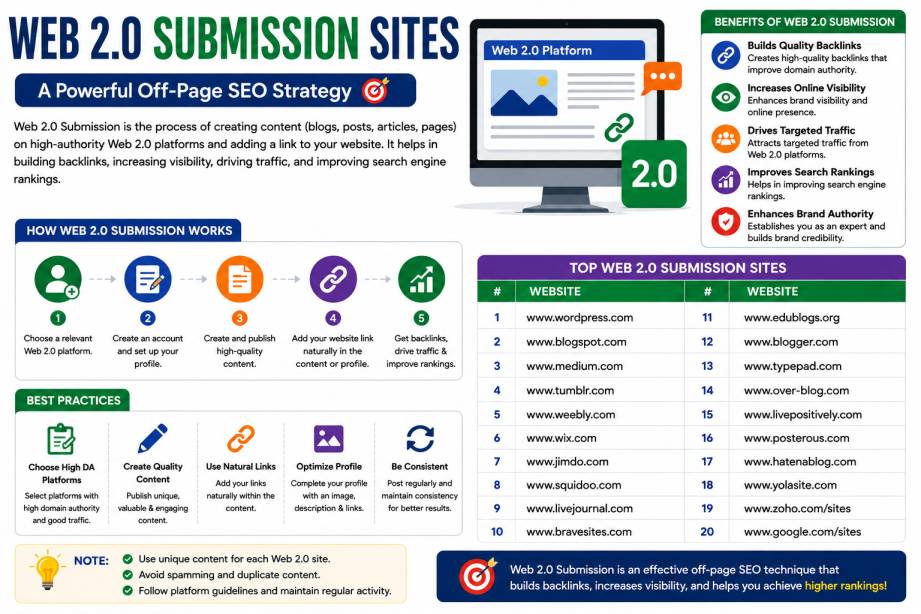
Web 2.0 submission remains one of the most popular off-page SEO strategies for building backlinks, increasing brand visibility, and supporting website rankings. Although SEO continues to evolve, high-quality Web 2.0 platforms still provide opportunities to publish valuable content, create contextual backlinks, and strengthen your website’s authority.
When used correctly, Web 2.0 sites can help diversify your backlink profile, improve indexing, and generate referral traffic. However, success depends on creating unique content and focusing on quality rather than mass submissions.
This guide explains what Web 2.0 submission sites are, their SEO benefits, how to use them effectively, and best practices for safe backlink building in 2026.
Key Takeaways
- Web 2.0 sites allow users to publish content and create contextual backlinks.
- High-quality content performs better than mass-produced submissions.
- Focus on authoritative platforms with strong trust signals.
- Use natural anchor text and avoid over-optimization.
- Publish consistently instead of creating large numbers of links at once.
- Combine Web 2.0 backlinks with other SEO strategies for long-term growth.
Table of Contents
- What Are Web 2.0 Submission Sites?
- Why Web 2.0 Sites Still Matter for SEO
- Benefits of Web 2.0 Backlinks
- How to Use Web 2.0 Sites Effectively
- Best Web 2.0 Platforms for SEO
- Best Practices for Web 2.0 Link Building
- Common Mistakes to Avoid
- Frequently Asked Questions
- Conclusion
What Are Web 2.0 Submission Sites?
Web 2.0 submission sites are platforms that allow users to create and publish their own content, blogs, articles, or mini-websites.
Unlike traditional websites where only administrators can publish content, Web 2.0 platforms give users control over:
- Content creation
- Page structure
- Internal linking
- External linking
- Images and media
This flexibility makes them useful for building contextual backlinks and supporting content marketing campaigns.
Popular examples include:
- WordPress.com
- Blogger
- Medium
- Tumblr
- Google Sites
- Weebly
- Wix
- Jimdo
- Strikingly
These platforms have strong authority and are frequently crawled by search engines.
Why Web 2.0 Sites Still Matter for SEO in 2026
Some marketers mistakenly believe Web 2.0 backlinks no longer work. In reality, they remain valuable when used strategically.
Modern SEO focuses heavily on:
- Content quality
- Topical relevance
- User experience
- Brand authority
Web 2.0 properties allow businesses to create supporting content around important topics and link naturally to relevant pages on their main website.
Instead of creating hundreds of low-quality pages, successful marketers build a smaller number of well-developed Web 2.0 properties that provide genuine value.
Benefits of Web 2.0 Backlinks
1. Build Contextual Backlinks
One of the biggest advantages of Web 2.0 platforms is the ability to place backlinks within relevant content.
Contextual links generally provide more value than isolated profile or directory links.
2. Improve Content Distribution
You can repurpose existing content into:
- Tutorials
- Guides
- Case studies
- Resource pages
- Industry insights
This expands your reach beyond your primary website.
3. Faster Indexing
High-authority Web 2.0 websites are crawled frequently by search engines.
Links from these platforms can help search engines discover new pages more quickly.
4. Increase Referral Traffic
Well-written content published on trusted platforms can attract visitors who may eventually become customers.
5. Strengthen Brand Visibility
Publishing across multiple platforms increases the number of locations where potential customers can find your business online.
6. Support Topical Authority
Creating content clusters around specific subjects helps reinforce expertise and relevance within your niche.
How to Use Web 2.0 Sites Effectively
Many people misuse Web 2.0 sites by treating them purely as backlink sources. The best results come from treating them as real publishing platforms.
Step 1: Select High-Quality Platforms
Focus on trusted websites with active communities and strong authority.
Start with:
- WordPress.com
- Blogger
- Medium
- Google Sites
- Tumblr
Step 2: Create Complete Profiles
Add:
- Profile photo or logo
- Business information
- Website URL
- Social media links
- Professional bio
Complete profiles appear more trustworthy.
Step 3: Develop Content Around Key Topics
Choose topics closely related to your primary website.
For example:
If your website focuses on SEO, create content about:
- Link building
- Local SEO
- Technical SEO
- Keyword research
- Content marketing
Step 4: Publish Original Content
Avoid copying articles directly from your website.
Instead:
- Rewrite content
- Expand ideas
- Create unique angles
- Add new examples
Step 5: Add Natural Backlinks
Include links only where they genuinely help readers.
Link to:
- Relevant blog posts
- Service pages
- Resources
- Case studies
Avoid excessive linking.
Step 6: Track Performance
Monitor:
- Traffic
- Indexed pages
- Referral visitors
- Backlink growth
This helps identify which platforms provide the best results.
Best Web 2.0 Platforms for SEO
High-Authority Web 2.0 Sites
WordPress.com
Ideal for creating detailed blogs, tutorials, and educational content.
Blogger
A free platform owned by Google that remains useful for supporting content.
Medium
Excellent for thought leadership and content distribution.
Tumblr
Useful for shorter content, visuals, and niche communities.
Google Sites
Simple, fast, and effective for creating resource hubs.
Weebly
Suitable for small microsites and landing pages.
Wix
Offers flexibility for creating professional-looking pages.
Jimdo
A beginner-friendly website builder for supporting content projects.
Strikingly
Useful for simple one-page websites and branded resources.
Notion Public Pages
Increasingly popular for publishing guides, documentation, and resources.
300+ High DA & PA Web 2.0 Submission Sites List
Below is a quick-start table with top platforms by DA tier. Most are free submission sites, though some offer paid upgrades. Verify each site’s current status and re-check DA and PA before publishing, since metrics can change. A larger 300+ list follows after the table.
| Website Name | DA Tier | PA | Submission Link |
|---|---|---|---|
| WordPress.com | 90+ | Varies by page | https://wordpress.com/start |
| Blogger.com | 90+ | Varies by page | https://www.blogger.com/about/ |
| Sites.Google.com | 90+ | Varies by page | https://sites.google.com/new |
| Medium.com | 90+ | Varies by page | https://medium.com/ |
| Tumblr.com | 70–89 | Varies by page | https://www.tumblr.com/register |
| Weebly.com | 70–89 | Varies by page | https://www.weebly.com/ |
| Wix.com | 90+ | Varies by page | https://www.wix.com/ |
| Jimdo.com | 70–89 | Varies by page | https://www.jimdo.com/ |
| Strikingly.com | 70–89 | Varies by page | https://www.strikingly.com/ |
| Site123.com | 70–89 | Varies by page | https://www.site123.com/ |
| Webnode.com | 70–89 | Varies by page | https://www.webnode.com/ |
| Yola.com | 50–69 | Varies by page | https://www.yola.com/ |
| Ucoz.com | 50–69 | Varies by page | https://www.ucoz.com/ |
| Over-Blog.com | 50–69 | Varies by page | https://en.over-blog.com/ |
| LiveJournal.com | 70–89 | Varies by page | https://www.livejournal.com/ |
| DeviantArt.com | 70–89 | Varies by page | https://www.deviantart.com/join |
| HubPages.com | 70–89 | Varies by page | https://hubpages.com/ |
| Bravenet.com | 50–69 | Varies by page | https://www.bravenet.com/ |
| Own Free Website | 50–69 | Varies by page | https://www.own-free-website.com/ |
| Kinja.com | 70–89 | Varies by page | https://kinja.com/ |
| Webme.com | 50–69 | Varies by page | https://webme.com/ |
| Zoho Sites | 70–89 | Varies by page | https://www.zoho.com/sites/ |
| Rediff Mail Enterprise | 70–89 | Varies by page | https://businessemail.rediff.com/create-business-website |
| Issuu.com | 90+ | Varies by page | https://issuu.com/ |
| About.me | 70–89 | Varies by page | https://about.me/ |
| Carrd.co | 70–89 | Varies by page | https://carrd.co/ |
| Notion.site | 70–89 | Varies by page | https://www.notion.so/ |
| Substack.com | 70–89 | Varies by page | https://substack.com/ |
| Quora Spaces | 90+ | Varies by page | https://www.quora.com/spaces |
| GitBook.com | 70–89 | Varies by page | https://www.gitbook.com/ |
| Beacons.ai | 50–69 | Varies by page | https://beacons.ai/ |
| Tilda.cc | 70–89 | Varies by page | https://tilda.cc/ |
| Leadpages.net | 70–89 | Varies by page | https://www.leadpages.com/ |
| Webflow.io | 70–89 | Varies by page | https://webflow.com/ |
| Canva Sites | 70–89 | Varies by page | https://www.canva.com/website-builder/ |
| Google Docs Publish | 90+ | Varies by page | https://docs.google.com/ |
| Google Drive Public | 90+ | Varies by page | https://drive.google.com/ |
| Note.com | 70–89 | Varies by page | https://note.com/ |
| Edublogs.org | 70–89 | Varies by page | https://edublogs.org/ |
| Webgarden.com | 50–69 | Varies by page | https://www.webgarden.com/ |
Note: The full 300+ list includes many more niche builders, blogging hubs, and profile-capable platforms. Always validate DA and PA during your final edit for 2026.
Best Practices for Web 2.0 Link Building
Focus on Quality Content
Each property should provide genuine value.
Aim for:
- 600–1000 words
- Clear headings
- Helpful information
- Images where appropriate
Use Natural Anchor Text
Mix different anchor types:
- Brand name
- Website URL
- Generic anchors
- Partial-match keywords
Avoid excessive exact-match anchors.
Maintain Consistent Publishing
Publishing one or two quality posts each month is often more effective than creating dozens of pages at once.
Link to Authority Sources
Including references to trusted sources can improve credibility.
Update Existing Properties
Refresh content periodically with:
- New statistics
- Updated examples
- Additional resources
This keeps properties active and relevant.
Diversify Link Destinations
Don’t point every backlink to your homepage.
Link to:
- Blog posts
- Service pages
- Resource pages
- Landing pages
Common Mistakes to Avoid
Publishing Duplicate Content
Search engines prefer unique content. Avoid posting identical articles across multiple platforms.
Keyword Stuffing
Overusing keywords reduces readability and can trigger spam signals.
Creating Thin Content
Very short articles with little value rarely perform well.
Building Too Many Links Too Quickly
Gradual growth appears more natural and sustainable.
Ignoring Profile Optimization
Empty profiles reduce trust and credibility.
Using Automated Tools
Mass automation often leads to low-quality content and weak results.
Frequently Asked Questions
Are Web 2.0 submission sites still effective in 2026?
Yes. They remain useful for content distribution, contextual backlinks, indexing support, and brand visibility when used correctly.
How many Web 2.0 backlinks should I create each month?
Quality matters more than quantity. For most websites, 5–10 quality Web 2.0 backlinks per month is a reasonable starting point.
Are Web 2.0 sites free?
Most major Web 2.0 platforms offer free plans with optional premium upgrades.
Do Web 2.0 backlinks help rankings?
They can support SEO by strengthening your backlink profile and increasing topical relevance, especially when combined with other link-building strategies.
Is duplicate content safe on Web 2.0 sites?
No. Always create unique content for each platform to maximize value and avoid potential SEO issues.
Conclusion
Web 2.0 submission sites continue to be a valuable part of modern off-page SEO when approached with a quality-first mindset. Rather than creating hundreds of low-value pages, focus on developing useful content that helps readers while naturally supporting your website.
By choosing authoritative platforms, publishing unique articles, using natural anchors, and maintaining consistent activity, Web 2.0 properties can contribute to stronger rankings, better visibility, and long-term SEO growth.
The most successful SEO strategies combine Web 2.0 submissions with content marketing, guest posting, business listings, profile creation, digital PR, and other trusted backlink-building techniques. Together, these efforts create a diverse and sustainable backlink profile that supports long-term success.