

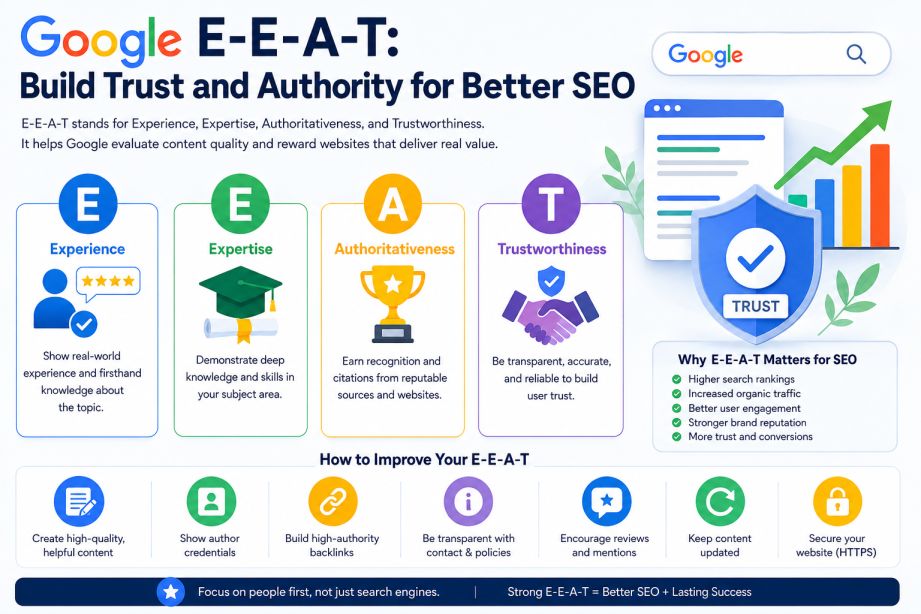
Search engine optimization keeps evolving, but one principle remains essential for long-term success: Google E-E-A-T. Standing for Experience, Expertise, Authoritativeness, and Trustworthiness, E-E-A-T helps Google determine whether content deserves visibility in search results.
For website owners, marketers, and businesses, understanding E-E-A-T is no longer optional. It plays a major role in how Google evaluates content quality, especially for websites covering sensitive topics such as health, finance, and legal advice. These are known as “Your Money or Your Life” (YMYL) topics because they can directly impact a person’s well-being, finances, or safety.
In this guide, we’ll explore what E-E-A-T means, why it matters for SEO, and how you can strengthen your website’s credibility to improve rankings.
Understanding Google’s E-E-A-T Framework
What Is E-E-A-T?
Google uses E-E-A-T as a quality framework to assess whether content is reliable, helpful, and created by knowledgeable individuals.
Experience
Experience refers to firsthand knowledge of a topic. Content created by someone who has personally used a product, visited a destination, or worked through a process often provides more value than generic information. Google increasingly rewards authentic experiences because they help users make informed decisions.
Expertise
Expertise demonstrates that the content creator possesses substantial knowledge in a particular field. This expertise may come from professional qualifications, industry certifications, academic credentials, or years of practical experience.
Authoritativeness
Authority is built when others recognize your knowledge and credibility. Backlinks from reputable websites, media mentions, citations, and industry recognition all contribute to a site’s authority.
Trustworthiness
Trust is the foundation of E-E-A-T. Google wants users to access accurate, transparent, and dependable information. Websites that clearly display contact information, maintain security standards, and provide honest content tend to earn greater trust.
E-E-A-T vs. E-A-T: What’s Different?
Google originally introduced E-A-T, focusing on Expertise, Authoritativeness, and Trustworthiness. Later, it expanded the framework by adding Experience.
This addition highlights the growing importance of firsthand knowledge. For example, a product review written by someone who has actually tested the product offers more value than content created solely from online research.
The inclusion of Experience helps Google surface content that reflects real-world insights rather than theoretical information alone.
How Google Assesses E-E-A-T
Search Quality Raters
Google employs human quality raters who evaluate websites using detailed Search Quality Evaluator Guidelines. Their feedback helps Google refine its algorithms and better identify high-quality content.
Algorithmic Signals
Google’s systems analyze numerous indicators, including:
- Backlinks from trusted websites
- Brand mentions across the web
- User engagement signals
- Content quality and relevance
- Website reputation
These signals collectively help determine whether a site demonstrates authority and trust.
Indirect Ranking Influence
E-E-A-T is not a direct ranking factor in the same way page speed or mobile usability may be. However, websites that consistently demonstrate E-E-A-T qualities often perform better because they naturally align with Google’s goal of delivering reliable information.
Why E-E-A-T Matters for SEO
Higher Search Visibility
Google aims to provide users with accurate and dependable information. Websites that demonstrate strong E-E-A-T are more likely to gain favorable rankings.
Essential for YMYL Websites
Health, finance, insurance, legal, and medical websites face greater scrutiny because inaccurate information can cause real harm. Strong E-E-A-T signals are particularly important in these industries.
Increased User Confidence
Visitors are more likely to engage with content, subscribe, contact your business, or make purchases when they trust your website.
Better Protection from Algorithm Updates
Many ranking fluctuations occur because websites fail to meet Google’s evolving quality standards. Building strong E-E-A-T helps create a more resilient SEO strategy.
How to Improve E-E-A-T for Better Rankings
1. Create Helpful, People-First Content
Focus on solving real problems rather than simply targeting keywords.
Best practices include:
- Sharing practical advice and insights
- Including real examples and case studies
- Answering common user questions
- Providing actionable information
Content should prioritize user value before search engine rankings.
2. Showcase Expertise
Make it clear why readers should trust your information.
Ways to demonstrate expertise:
- Add detailed author biographies
- Highlight certifications and credentials
- Reference credible sources
- Publish in-depth, well-researched content
Expert-led content tends to perform better because it provides greater depth and accuracy.
3. Build Authority in Your Industry
Authority develops over time through consistent quality and recognition.
Strategies include:
- Earning backlinks from reputable websites
- Publishing original research and insights
- Securing media mentions
- Collaborating with industry professionals
Creating topic clusters and pillar content can also strengthen topical authority.
4. Strengthen Trustworthiness
Trust should be visible throughout your website.
Important trust signals include:
- HTTPS website security
- Transparent contact information
- Clear privacy policies
- Honest claims and disclosures
- Consistent branding and messaging
Visitors should never question the legitimacy of your business.
5. Encourage Reviews and User Feedback
Authentic reviews help establish credibility and social proof.
Effective approaches include:
- Showcasing customer testimonials
- Collecting verified reviews
- Featuring client success stories
- Highlighting expert endorsements
Avoid fake reviews or misleading testimonials, as they can damage trust.
6. Improve Technical SEO and Site Experience
Technical quality contributes to overall trust and usability.
Focus on:
- Fast page load times
- Mobile responsiveness
- Structured data implementation
- Clear navigation
- Accessibility improvements
A technically sound website creates a better user experience and supports SEO performance.
Common E-E-A-T Mistakes to Avoid
Publishing Thin or Generic Content
Content that lacks depth, originality, or practical value rarely performs well in search results.
Hiding Author Information
Anonymous content can reduce credibility, especially in competitive or sensitive industries.
Ignoring Website Security
Users expect websites to be secure. Missing HTTPS protection can negatively affect trust.
Building Low-Quality Backlinks
Links from spammy or irrelevant websites may damage your site’s reputation rather than improve it.
Overusing AI Without Human Review
AI tools can assist content creation, but expert editing and fact-checking remain essential for maintaining quality and trustworthiness.
Conclusion
Google’s E-E-A-T framework has become a critical component of modern SEO. Websites that demonstrate genuine experience, subject-matter expertise, industry authority, and trustworthiness are more likely to earn visibility and maintain rankings over time.
Rather than chasing short-term SEO tactics, focus on creating valuable content, showcasing expertise, earning recognition, and building trust with your audience. These efforts not only improve search performance but also strengthen your brand’s reputation and credibility.
As Google’s algorithms continue to evolve, E-E-A-T will remain one of the most effective ways to establish long-term SEO success.